
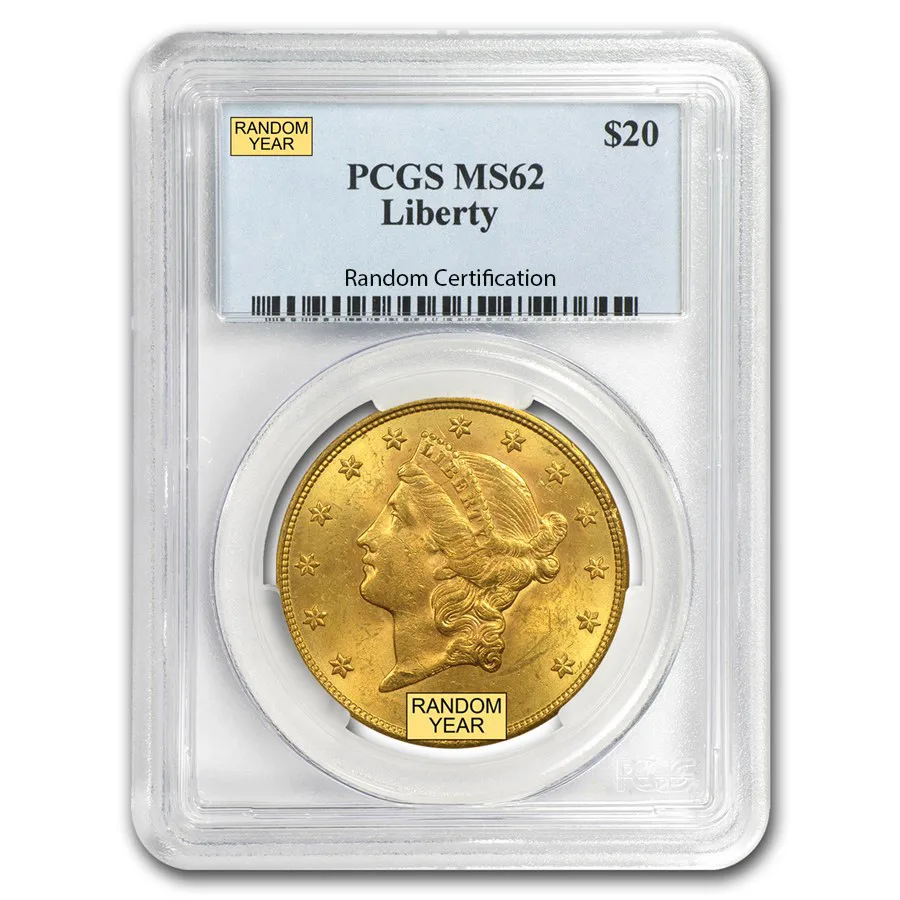
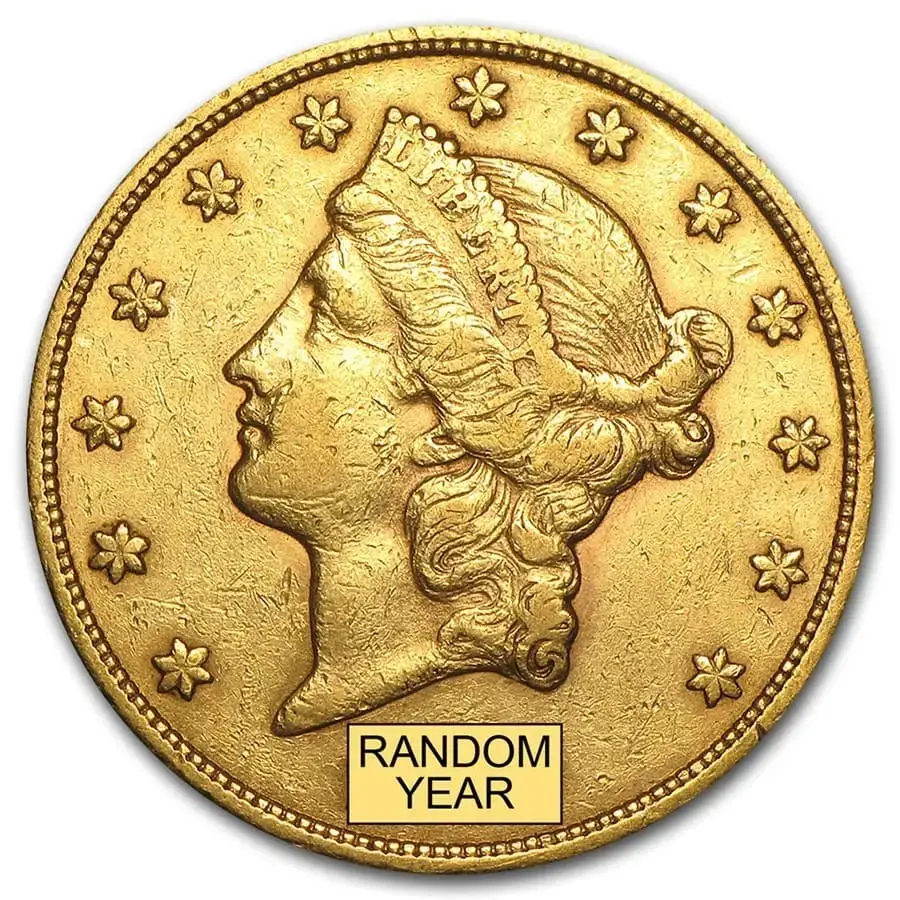
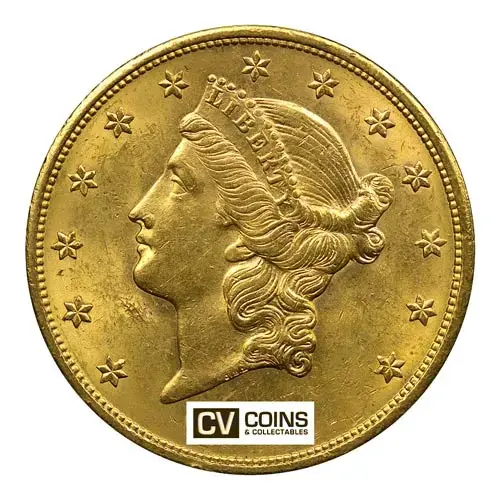
$20 Liberty Double Eagle (1850-1907)
The Liberty Head Double Eagle—often called the Coronet Head—was the workhorse of 19th-century U.S. commerce and international settlement. Designed by James B. Longacre and struck in .900 fine gold, it carries nearly a full troy ounce of gold, which kept many examples overseas in bank reserves; the wave of repatriations a century later is why some late dates remain relatively affordable today.
The series breaks into three logical subtypes that matter both historically and for type collecting. Type 1 (1850–1866) has no “IN GOD WE TRUST” and the denomination reads “TWENTY D.” These Civil War–era coins are rich in history and include some of the series’ most dramatic rarities. Type 2 (1866–1876) adds the motto but retains “TWENTY D.” This short middle run includes the famous transitional 1866-S No Motto—created when an old reverse die slipped into service after the motto was introduced. Type 3 (1877–1907) spells out “TWENTY DOLLARS” and is where most collectors find their eye-appeal “type” examples, thanks to plentiful 1890s–1904 dates repatriated from Europe.
Rarity and personality vary strongly by mint. Carson City issues (1870-CC foremost, then early 1870s) are frontier gold with lower mintages and a rugged look; originality means everything and commands fierce premiums. New Orleans pieces cluster in the 1850s–1860s and are generally tougher, with center softness not unusual. San Francisco is the workhorse mint—many Type 3 S-mints offer the best luster-per-dollar, though bagmarks are common from heavy handling. Philadelphia runs the gamut from scarce Civil War dates to common 1904s and is the home for proofs. Denver appears only at the end (1906–1907) and is typically chased by mintmark set builders.
Varieties give this series extra depth. The 1861 Paquet reverse (tall, narrow lettering with a slimmer rim) exists for both Philadelphia and San Francisco—San Francisco pieces are collectible rarities; Philadelphia is a trophy-level rarity. The 1866-S No Motto, as noted, is a major transitional variety. Scattered repunched dates and mintmark placements across the 1860s–1870s can bring premiums when dramatic and properly attributed. On the market-rarity side, 1854-O is a legendary stopper; 1856-O and 1860-O are also coveted; early CC dates 1871–1873 are notably scarce even in circulated grades.
Grading and eye appeal hinge on a few predictable traits. Liberty’s cheek and the hair above the ear are the high points; on the reverse, look to the eagle’s wing and shield. Because these are big, heavy coins, even nice Mint State pieces show scattered contact—MS62–63 with lively luster and fewer hits in focal areas is a sweet spot for value; true gems are rare for most dates. Color matters: original “dirty” skin with rose-to-greenish gold tones is prized; bright overdipped surfaces with hairlines trade at discounts. Proofs should show squared rims and mirrored fields, often with cameo contrast, but hairlines from old wipes are common and very value-sensitive.
Provenance can add both romance and complexity. Shipwreck recoveries—most famously SS Central America (supplying spectacular 1857-S examples) and Brother Jonathan—produce certified, pedigreed coins with distinctive surfaces. Some show “saltwater effect” noted on the label; desirability depends on how pleasing those surfaces are relative to non-recovered peers.
Specs (quick reference)
-
Designer: James B. Longacre
-
Composition: .900 gold, .100 copper; AGW 0.9675 troy oz
-
Weight: 33.436 g; Diameter: ~34 mm; Edge: Reeded
-
Mints: Philadelphia (—), New Orleans (O), San Francisco (S), Carson City (CC), Denver (D, 1906–1907)
-
Subtypes: Type 1 (1850–1866 No Motto, “TWENTY D.”); Type 2 (1866–1876 Motto, “TWENTY D.”); Type 3 (1877–1907 Motto, “TWENTY DOLLARS”)
Key things to look for
-
Verify subtype (motto/no motto; “TWENTY D.” vs “TWENTY DOLLARS”).
-
Screen 1861s for Paquet reverse diagnostics; check 1866-S for No Motto transitional.
-
Check weight/diameter and luster flow around mintmarks to sniff out added or moved mintmarks.
-
Prioritize cheek cleanliness, natural color/skin, and lively cartwheel over a single grade point.
-
Expect normal strike quirks (CC/O often softer centers; S-mints satiny with bagmarks).
-
For scarce dates, stick to PCGS/NGC; a CAC bean can be a useful tie-breaker on eye appeal.
-
Shipwreck pieces: confirm pedigree on the label and decide if the surface look justifies the premium.