
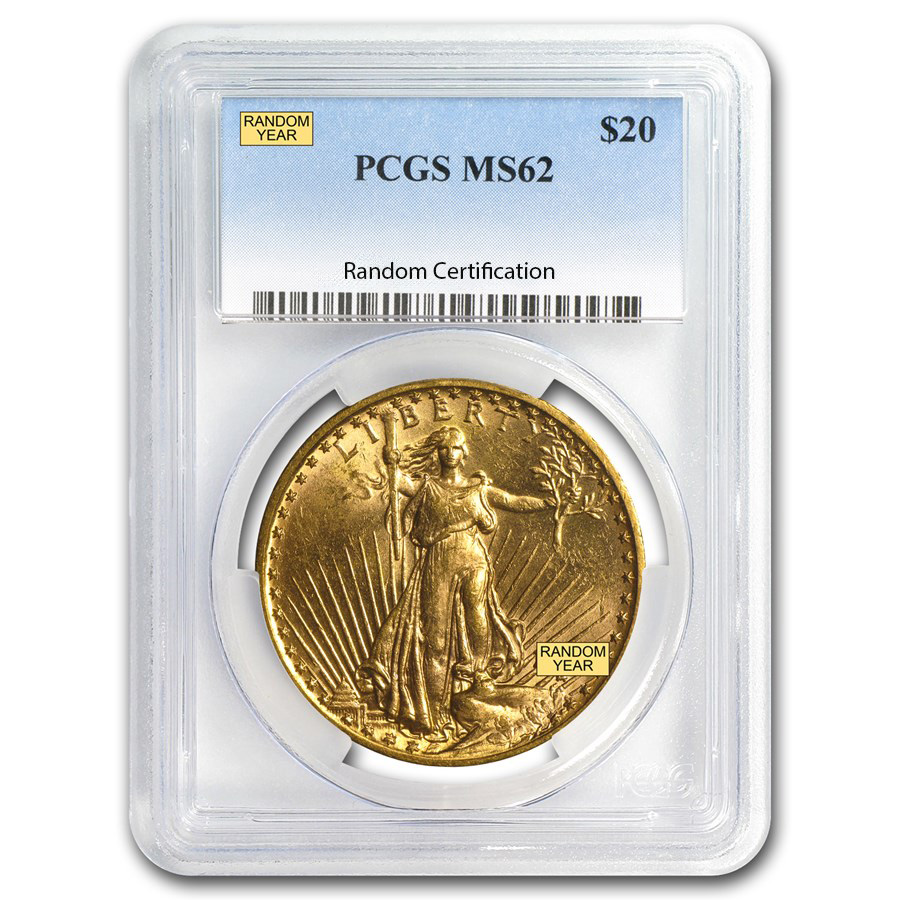
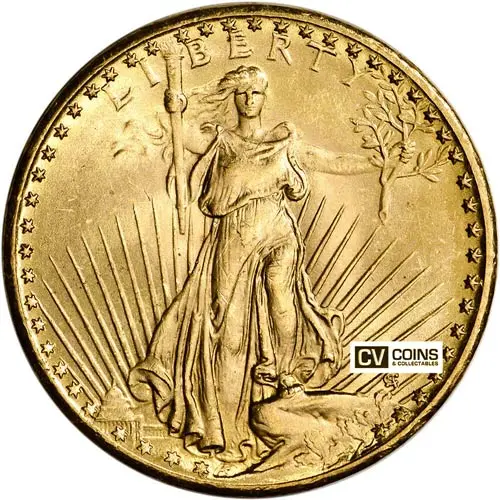
$20 Saint-Gaudens Double Eagle (1907-1933)
Widely viewed as America’s most beautiful coin, the Saint-Gaudens Double Eagle began in ultra-ambitious high relief at Theodore Roosevelt’s urging, then was lowered by Charles Barber so it could stack and strike efficiently. Early pieces (1907 and part of 1908) carry no motto; Congress restored IN GOD WE TRUST later in 1908. The iconic 1907 High Relief shows Roman numerals MCMVII and exists as “wire rim” and “flat rim” variants; the regular-issue low-relief coins use Arabic numerals. A small design update in 1912 raised the obverse star count from 46 to 48 to reflect new states. The series kept a lettered edge—E • PLURIBUS • UNUM—throughout.
Date and mint personalities matter. “Type” coins with strong eye appeal are plentiful among 1924, 1927, and 1928 Philadelphia issues (thanks to European bank repatriations). Balanced, affordable choices also appear in many 1910s issues, though luster and contact marks vary. Tough dates that anchor advanced sets include 1920-S, 1921, 1926-D, 1926-S, 1927-D (a legendary rarity), 1930-S, 1931-D, and several late-dates with low survivors. The 1908-S No Motto is notably scarcer than same-year Philadelphia. Always separate mintage from survival—post-1933 melts and banking patterns left some “big mintage” issues surprisingly elusive in choice grades.
Grading and eye appeal hinge on the Saint’s broad, satiny fields and bold sculpting. Expect scattered ticks on the obverse field and Liberty’s thigh/knee, plus contact on the eagle’s wing and breast. Luster runs from soft satiny to blazing; coins with uninterrupted cartwheel and minimal hits in focal areas often punch above their numeric grade. Step-ups from MS64 → MS65 can be dramatic in price for better dates, so buy the cheek/fields, not just the label. For proofs (1908–1915), remember these are matte/sandblast or Roman-finish pieces—not mirror proofs—so look for squared rims, granular texture, and unbroken surfaces; hairlines or “brightened” examples sink value.
Authenticity and originality deserve special attention. The series is heavily counterfeited (including deceptive gold-alloy casts and transfer-die strikes). Added mintmarks—especially fabrications of dream dates like 1927-D—are common; check exact mintmark placement/tilt and undisturbed luster flow around the letters. The edge lettering should be crisp and evenly spaced with clean star separators. Weight, diameter, and ring are reliable sanity checks, but for anything scarce, insist on PCGS/NGC; a CAC sticker remains a strong tie-breaker on eye appeal and marketability.
Strategy-wise, you can (1) build a two-type set (No Motto and With Motto) and add a 1907 High Relief if budget allows; (2) assemble a mintmark/date run emphasizing San Francisco and Denver challenges; (3) go “condition type,” targeting the flashiest luster and cleanest fields among common dates; or (4) specialize in proofs or old-holder/CAC pieces. Whatever the lane, prioritize strike, luster, and originality—and be realistic about the steep premium curve above MS64 for many dates.
Specs (quick reference)
-
Designer: Augustus Saint-Gaudens (relief lowered by Charles E. Barber in 1907)
-
Composition: .900 gold, .100 copper; AGW 0.9675 troy oz
-
Weight: 33.436 g; Diameter: ~34 mm; Edge: Lettered “E • PLURIBUS • UNUM”
-
Subtypes: 1907 High Relief (Roman numerals); 1907–early 1908 No Motto; mid-1908–1933 With Motto; 46 stars (to 1911), 48 stars (1912–1933)
-
Mints: Philadelphia (—), Denver (D), San Francisco (S)
Key things to look for
-
Confirm motto status (1908 has both) and star count (46 vs 48) for attribution.
-
Distinguish High Relief (steep devices, stronger sculpting; 1907 MCMVII) from low relief.
-
Verify weight/diameter and study mintmark area for added letters or tool marks.
-
Favor coins with clean obverse fields, strong cartwheel, and undisturbed color/skin.
-
For better dates, rely on PCGS/NGC; CAC can materially aid liquidity and resale.
-
Proofs (1908–1915): look for matte/Roman finishes, squared rims, and no “brightened” surfaces.