
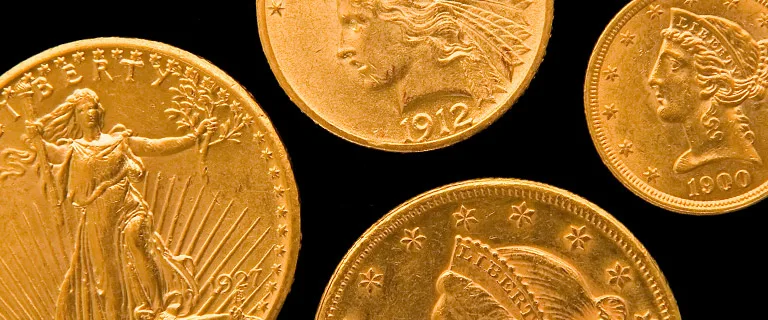

This article is based on established U.S. government records, including Executive Order 6102, the Emergency Banking Act of 1933, and the Gold Reserve Act of 1934, along with Federal Reserve and U.S. Treasury historical data on gold policy, international gold flows, and monetary reform during the Great Depression. Numismatic interpretations reflect widely accepted scholarship on pre-1933 U.S. gold coinage, survival rarity, and collector standards.
For most of American history, gold coins were not treated as investment products or hedges. They were money. These coins circulated in everyday commerce, anchored the dollar, and represented personal security for households and institutions alike. In February’s focus, we explain why that system ended, how gold was removed from private hands, how much gold left the United States during this period, and why pre-1933 gold coins survive today as one of the most important collectible categories in numismatics.
Gold as Money Before 1933
Before 1933, gold coins were more than just objects of value. They were integral to American daily life and the economy. People used gold coins to pay for groceries, rent, and other routine expenses. Families often kept coins safely stored at home, while banks held them in vaults as a guarantee of solvency. Unlike paper currency, which could be printed without limit, gold had intrinsic value.
Gold coins were also trusted internationally. Countries settled trade imbalances through shipments of gold, and the United States, emerging as a major economic power after World War I, held vast reserves. These coins circulated freely, and confidence in their value reinforced both domestic and international trust in the dollar. Gold coins provided stability, security, and liquidity. This is the combination that would soon be tested during the Great Depression.
The Great Depression and Gold Hoarding
The stock market crash of 1929 triggered widespread fear and uncertainty. As banks failed and credit froze, many Americans began hoarding gold coins and certificates, withdrawing them from circulation and storing them privately. From an individual perspective, this was a rational choice, protecting wealth during a period of economic instability.
However, hoarding gold had profound consequences for the national economy. The United States was on the gold standard, meaning each dollar in circulation was backed by a corresponding amount of gold. As private citizens withdrew gold or it flowed abroad, the government’s ability to expand the money supply was severely constrained. Deflation deepened, wages fell, and debts became harder to repay. What had once been a stabilizing force, gold, now limited economic recovery.
Executive Order 6102: The Turning Point
On April 5, 1933, President Franklin D. Roosevelt issued Executive Order 6102, fundamentally changing the role of gold coins in American life. The order prohibited most private ownership of monetary gold and required Americans to turn coins, bullion, and certificates over to the Federal Reserve in exchange for paper currency at $20.67 per ounce.
Limited exemptions allowed individuals to retain:
- Certain rare and collectible coins
- Gold used for industrial, professional, or artistic purposes
- Small amounts of personal gold
Penalties for noncompliance were severe, including heavy fines and prison time.
For collectors, Executive Order 6102 represents the most important dividing line in U.S. gold coin history. Coins that survived, whether hidden, overlooked, exported, or exempted, form the foundation of the pre-1933 gold coin market today. Survival was accidental, not planned, making these coins historically and numismatically significant.
How Gold Left the United States
While Executive Order 6102 addressed domestic ownership, it did not prevent gold from leaving the country. Leading up to and following 1933, large amounts of gold moved overseas as foreign governments and institutions redeemed dollars under international agreements.
The U.S. operated within a global gold settlement system, and foreign claims on American gold increased as confidence in paper currencies weakened worldwide. Shipments of gold to Europe and other regions reduced U.S. reserves even as domestic ownership was being curtailed. For collectors, this explains why so much American gold coinage disappeared, not only through melting but also through permanent export and international absorption.
Why Confiscation Was Legally Possible
Roosevelt’s actions were backed by emergency powers. Shortly after taking office, he declared a national emergency, which Congress swiftly ratified through the Emergency Banking Act. This expanded presidential authority allowed older wartime legislation to be applied domestically.
The administration also relied on provisions of the Trading with the Enemy Act, reinterpreted under emergency conditions. While controversial, these measures were upheld by the courts, enabling the suspension of private gold ownership in a manner that would be impossible under normal circumstances.
The Gold Reserve Act and Revaluation
In 1934, Congress passed the Gold Reserve Act, transferring all gold to the U.S. Treasury and revaluing it from $20.67 to $35 per ounce. This effectively devalued the dollar overnight and expanded the money supply. By confiscating gold at the old price and revaluing it, the government captured the difference, centralizing control of this critical resource.
After this point, gold coins ceased to function as circulating money in the U.S., shifting instead to a reserve asset and, eventually, a collectible.
Melting, Consolidation, and Fort Knox
The collection of millions of gold coins created logistical challenges. Most coins were melted into bars for easier storage and accounting. These bars were then secured in government facilities, most famously Fort Knox.
From a numismatic perspective, this is why survival, not mintage, drives rarity in pre-1933 gold coins. High-production coins may be scarce today because they were melted, while others survived due to export, exemption, or accidental retention. Survival rarity adds a unique dimension to collecting and distinguishes these coins from modern bullion.
Restoration of Private Gold Ownership
Private gold ownership remained illegal for 41 years. In 1974, restrictions were lifted, allowing Americans to own gold freely once again. By then, the international gold standard had collapsed, and gold traded on open markets based on supply and demand rather than a statutory price.
Pre-1933 gold coins remained a closed historical category. They are finite, legally distinct, and permanently separated from modern bullion coins. Collectors value them for their historical context, survival rarity, and original surfaces.
Why This Era Matters to Collectors
Pre-1933 gold coins survived due to policy, crisis, and accident. They were not saved intentionally as collectibles, which gives them a unique appeal. Collectors focus on:
- Originality and surface quality
- Eye appeal and aesthetic condition
- Survival rarity rather than just date rarity
Coins with honest wear but original surfaces often outperform higher-grade coins that were cleaned or altered. Understanding this history helps collectors make informed decisions and appreciate the intrinsic and historical value of these coins.
Featured Picks This Month
Starter Picks
- $1 Liberty Head Gold Dollar Type 1 XF (Random Year) — Entry-level gold coin illustrating the transition from money to asset
- $20 Saint-Gaudens Gold Double Eagle BU (Random Year) — Common-date pre-1933 gold type with original surfaces
Collector Picks
- $1 Indian Head Gold Dollar Type 2 AU (Random Year) — Scarcer surviving U.S. gold type with strong eye appeal
- Great Britain Gold Coin Avg Circ (Random Year) — Foreign gold coin connected to gold outflows and international trade
- $20 (Random Year) Saint-Gaudens Gold Double Eagle PCGS MS62 — Premium-condition pre-1933 gold coin emphasizing survival rarity