
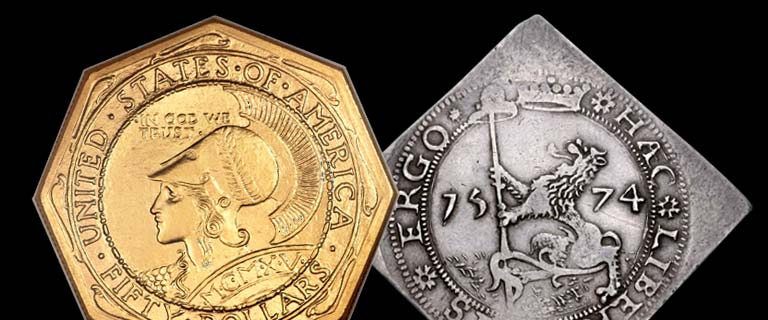

Coins are round for a reason. For most of history, circular coinage provided consistency, durability, and trust. A round coin strikes evenly, wears predictably, and can be easily stacked, counted, and transported.
When a coin deviates from that form, it is rarely accidental. It reflects a deliberate choice—one rooted in necessity, identity, or, in modern times, attention.
Odd-shaped coins occupy a unique place in numismatics because they force a different kind of question. Not just what is this coin, but why was it made this way—and does that matter today?
In many cases, the answer is yes.
Why Coins Were Not Always Round
In earlier periods, unusual shapes were practical. These designs solved real problems in everyday commerce:
- Coins with holes allowed them to be strung together for storage and transport in economies where large quantities of small denominations circulated daily
- Square and rectangular coins often came from hammer-struck production, where cutting metal into uniform round blanks was less efficient than working with flat sheets
- Concave or cup-shaped coins were functional tools designed to prevent clipping or distinguish denominations
These were not artistic experiments. They were functional solutions tied directly to how money was used. That functional origin is what gives many of these coins lasting importance—and in some cases, real monetary value.
When Shape Meets Rarity: The Panama-Pacific Octagonal $50 Gold Piece
At major auctions such as Heritage Auctions, some of the most recognizable odd-shaped coins have brought extraordinary prices. The 1915-S Panama-Pacific $50 gold piece, struck in an unmistakable octagonal shape, remains one of the most iconic examples in U.S. numismatics. High-grade specimens have sold for hundreds of thousands of dollars, not simply because of their unusual form, but because of their rarity, gold content, and historical significance tied to the Panama-Pacific Exposition.
The octagonal Panama-Pacific $50 gold piece, issued in 1915 for the Panama-Pacific International Exposition in San Francisco, stands as the only regularly issued non-round coin in United States coinage. Its distinctive eight-sided form was not merely a novelty, but a deliberate nod to the private Assay Office gold “slugs” of the California Gold Rush—large, irregularly shaped pieces that circulated in the same city decades earlier.
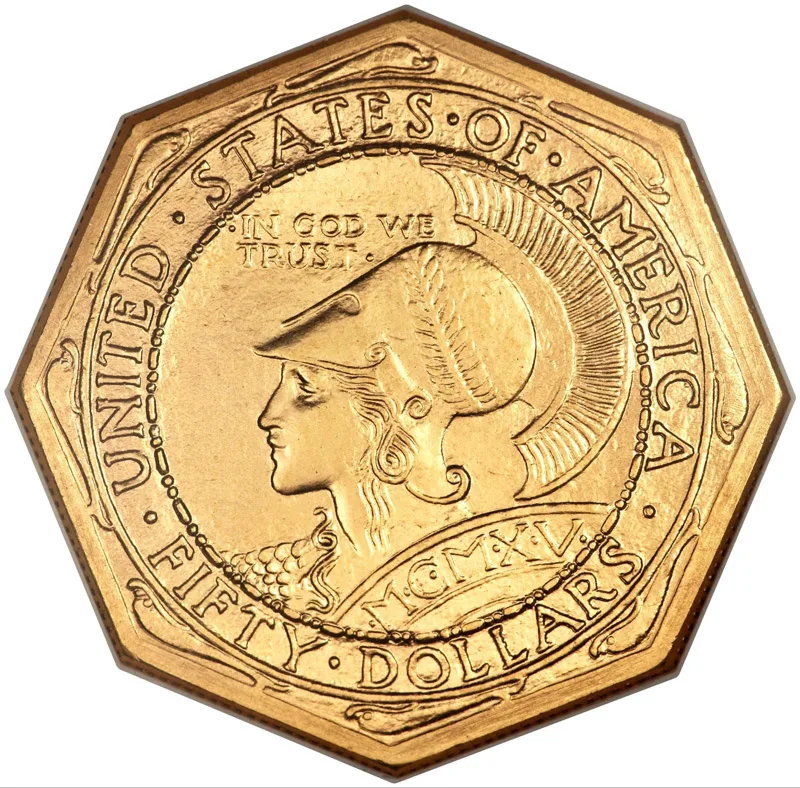
Key facts about the Panama-Pacific octagonal $50:
- Of the 1,500 octagonal coins struck, only 645 were sold, compared to 483 of the round version
- The remaining unsold pieces were returned to the United States Mint and melted, permanently reducing the surviving population
- Despite similar distribution challenges, the octagonal format proved more appealing to collectors at the time
- Its size, weight, and historical association made it the more desirable choice, especially for those who could acquire only one example of this substantial gold issue
Today, the coin illustrates a familiar principle seen throughout numismatics: when form carries both historical meaning and visual distinction, it can elevate a coin beyond its counterparts. In this case, the shape was not simply different—it connected the piece to an earlier chapter of American monetary history, reinforcing its status as one of the most iconic and sought-after commemorative coins ever produced.
European Klippe Coins: Shape Under Pressure
In Europe, square “klippe” coins—struck during times of siege—offer another example where shape and history intersect. These coins were cut from flat metal and struck quickly under emergency conditions, resulting in their distinctive square appearance. German and Austrian klippe thalers, particularly larger silver issues, have realized thousands to tens of thousands of dollars at auction when scarce types appear in strong condition.
This square Klippe 3 Taler of Archduke Leopold V, struck at the Hall mint circa 1635, represents the type of coin where shape, history, and scarcity intersect in a meaningful way. Issued posthumously under Claudia von Medici during her regency (1632–1646), the piece commemorates their marriage in 1626 and stands as a tangible link to the political and ceremonial life of Tyrol in the early 17th century.
Unlike modern novelty pieces, the square format here is not decorative—it reflects the method of production. Klippe coins were struck on cut metal rather than fully prepared round planchets, often during periods where efficiency or circumstance dictated form. That origin is part of what gives these coins lasting collector appeal.
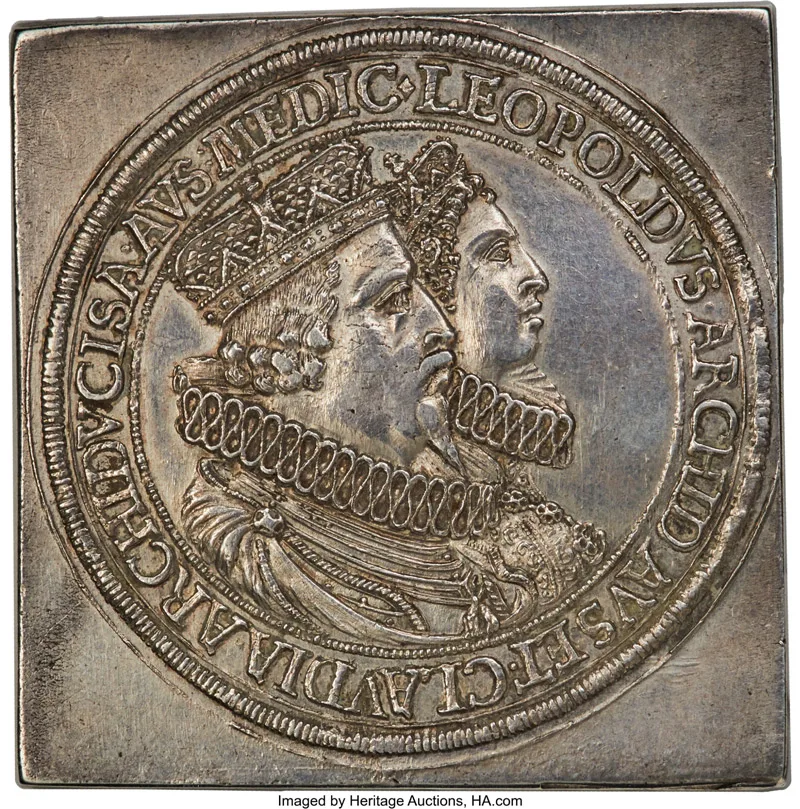
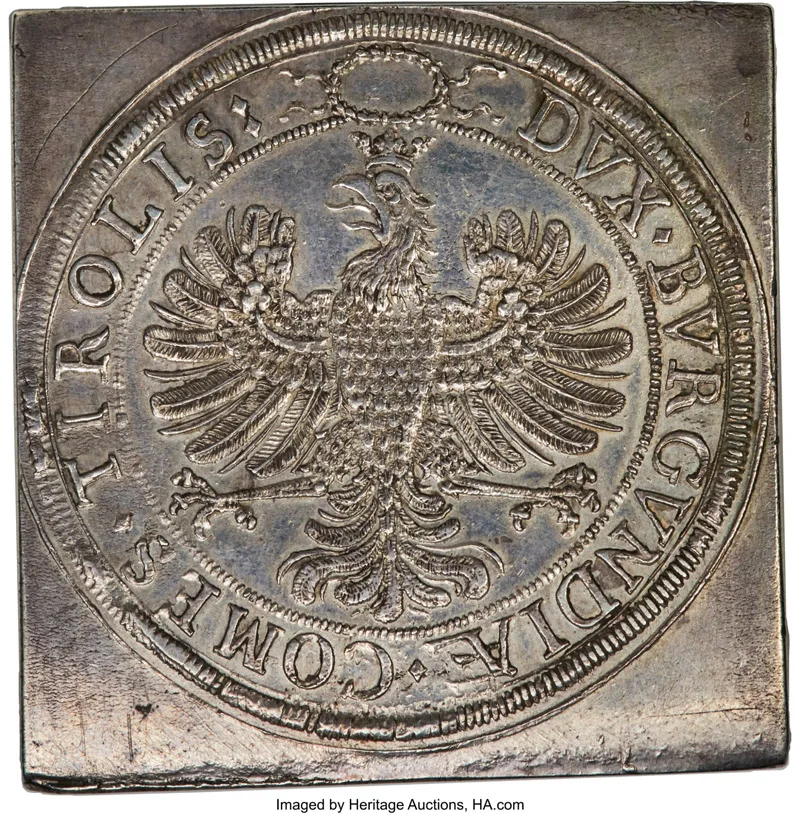
What makes this Klippe special:
- Weighs an impressive 85.33 grams
- Certified Mint State 60 by NGC
- Notably scarcer than the already rare 2 Taler issues of the same period
- Surfaces display the expected fabric of Klippe coinage, with slight waviness and light fissures, yet retain a strong, even tone
- The double portrait of Leopold and Claudia is sharply rendered, with finely engraved detail throughout and no meaningful weakness in strike
Coins of this type rarely appear in such preserved condition. More importantly, they illustrate a broader principle: the coins that achieve lasting value are not simply unusual in shape, but are backed by historical significance, limited survival, and sustained collector demand.
In this case, the square form is not the reason for its importance—it is the first indication that the coin belongs to a much deeper numismatic story.
Holed Coins and Long-Standing Monetary Systems
Even coins with holes—such as traditional Chinese cash coinage—show how function can translate into long-term collectibility. While most are common, certain rare varieties or high-grade examples have achieved strong auction results, sometimes reaching into the thousands. Their design, originally intended for practical use, now connects them to one of the longest-running monetary systems in history.
This exceptional coin originates from China’s Qing Dynasty under Emperor Wen Zong (Xian Feng) and represents an engraved master 500 cash piece, produced between March and August of 1854. A very rare high-grade example of this type realized $360,000 at auction in June 2025, underscoring both its rarity and historical importance.
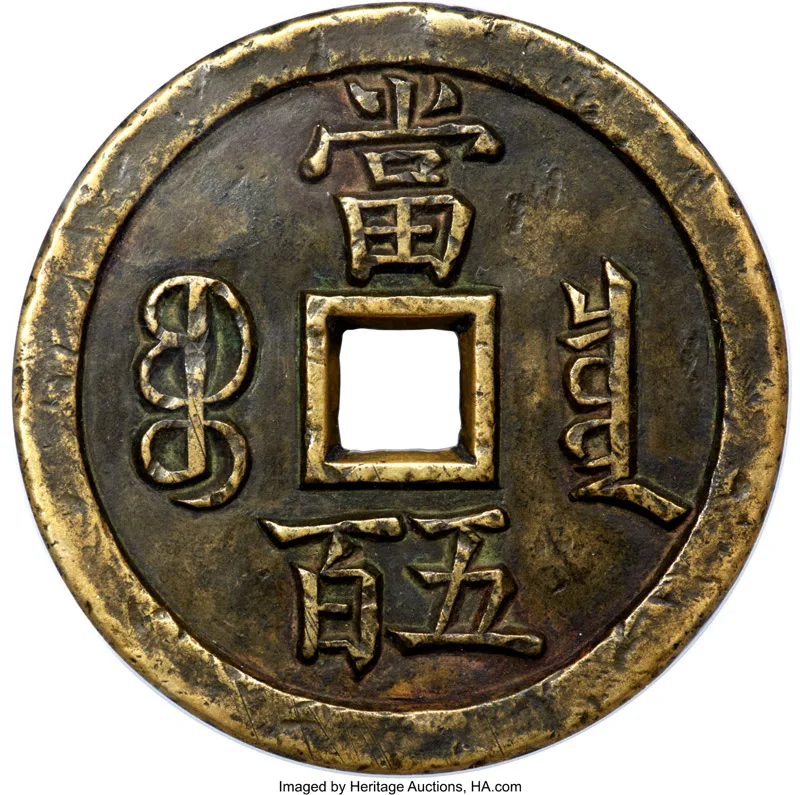
Unlike ordinary circulating coinage, this piece is directly tied to the work of a master engraver—the diaomu—who hand-carved the original design. These engraved masters served as the foundational prototypes for all subsequent coin production. Working from a blank copper planchet, the engraver meticulously incised each character by hand using fine tools. In high-grade examples such as this, the precision of that craftsmanship remains visible, with subtle tool marks revealing the human element behind its creation.
The engraved master coin process:
- Engraved pieces were presented to the Emperor for approval
- Upon acceptance, they were used to produce the first castings known as “mother coins”
- Mother coins, distinguished by their sharper detail and superior quality, were then employed to create molds for mass production
- From those molds came the circulating coinage used throughout the empire
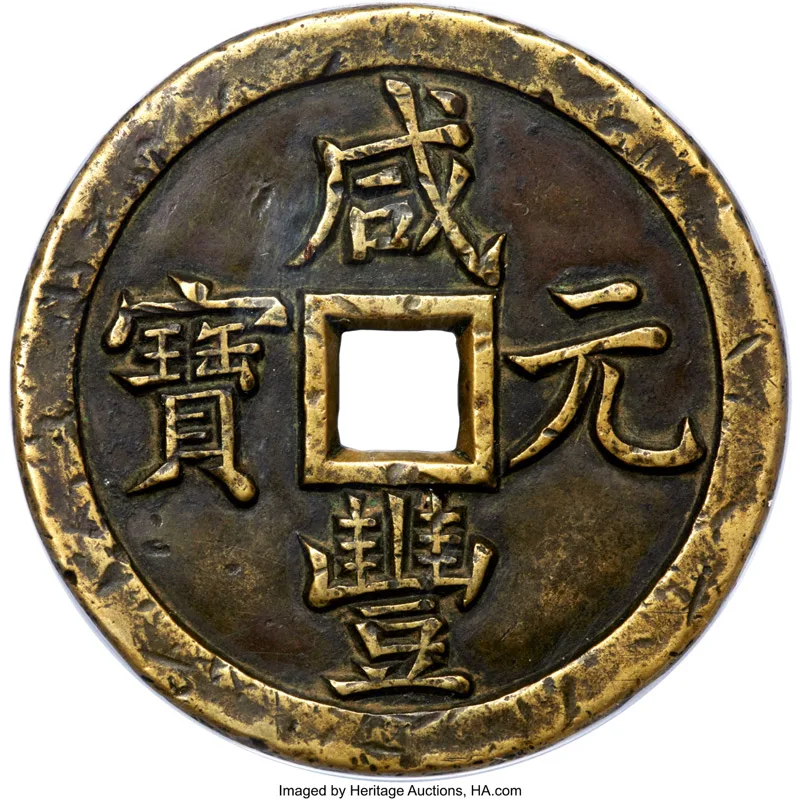
What makes this piece remarkable is not its unusual form alone, but its place at the very beginning of that process. It is not simply a coin—it is the origin point from which an entire issue was created.
What Actually Makes Odd-Shaped Coins Valuable
These results illustrate an important principle. Shape alone does not create value. The coins that bring five-figure numbers or more do so because they combine rarity, historical importance, and collector demand. Their unusual form is not the reason they are valuable—it is part of a larger story.
Coins that command strong prices typically share several characteristics:
- Rarity: Limited mintage or low survival rates
- Historical significance: Connection to meaningful events or periods
- Condition: Preservation and originality
- Collector demand: Ongoing interest in the market
This applies not only to silver and base metal coins, but also to gold coins, where both intrinsic value and historical context play a role. When these factors align, the coin’s shape becomes an added dimension rather than the primary driver.
Modern Odd-Shaped Coins: Innovation vs. Novelty
Modern coinage has introduced a different category entirely. Advances in minting technology now allow for virtually any shape to be produced. Coins can be multi-sided, curved, or formed into recognizable objects. While some represent genuine innovation, many are created simply to attract attention. Without a strong collector base or historical relevance, these pieces often struggle to maintain value once initial interest fades.
This is where collectors must be careful. Not every unusual coin is an opportunity. Some are designed to appear rare, but lack the long-term demand that supports sustained value.
The Role of Grading and Market Recognition
Grading often becomes part of this conversation, especially for higher-end pieces.
It is important to understand:
- Coins are not valuable because they are graded
- They are graded because they are already considered valuable or have the potential to be
Certification provides:
- Verification of authenticity
- Assessment of condition
- Increased confidence for buyers and sellers
However, a coin does not need to be graded to have value—it needs to be rare, desirable, and recognizable to the market.
Hidden Value in Everyday Collections
What makes this category particularly compelling is that many meaningful examples are already sitting unnoticed in collections that were never assembled with intent. Boxes of foreign coins—accumulated through travel, inheritance, or simple curiosity—often contain square, scalloped, or unusually shaped pieces that were set aside simply because they looked different.
That difference is not always random.
Sometimes it is the first sign that the coin deserves a closer look.
A collector who revisits those forgotten coins, who takes the time to understand why they were made the way they were, may discover something more than a novelty. They may uncover a piece of history, a connection to a moment of necessity or identity—and occasionally, something of real value.
The shape was never the answer. It was always the clue.
Frequently Asked Questions About Odd-Shaped Coins
Not necessarily. Shape alone does not determine value. Odd-shaped coins become valuable when they also have rarity, historical significance, strong condition, and collector demand.
Many non-round coins were created for practical reasons. Holes allowed coins to be strung together, while square or irregular shapes were easier to produce during certain minting processes or emergency conditions.
Klippe coins are typically square coins struck from flat metal sheets, often during times of siege or urgency. Their shape reflects the method of production rather than decorative intent.
Some modern issues may hold value, but many are produced primarily for novelty. Without long-term collector demand or historical importance, they may not appreciate over time.
Start by evaluating key factors:
• Rarity and mintage
• Condition and originality
• Historical context
• Market demand
If you are unsure, a professional appraisal can provide clarity.
In many cases, yes. When an unusual shape is combined with gold content, limited mintage, and historical significance, these coins can command strong premiums in the collector market.
Grading can be helpful for higher-value coins, especially when authenticity and condition impact pricing. For lower-value pieces, it may not always be necessary.
Conclusion: The Shape Is the Clue
Odd-shaped coins challenge assumptions about what currency should look like. More importantly, they reveal how function, history, and necessity shape the objects we often take for granted.
The most valuable coins in this category are not defined by their form alone. They are defined by what that form represents.
For collectors, the takeaway is simple:
- Look beyond appearance
- Understand the historical context
- Evaluate rarity and demand
Sometimes, the coins that stand out for their shape are the ones worth a closer look.
If you have unusual or foreign coins and are unsure of their value, CV Coins & Collectables can help. Our team provides expert appraisals and guidance to help you better understand what you have and what it may be worth.