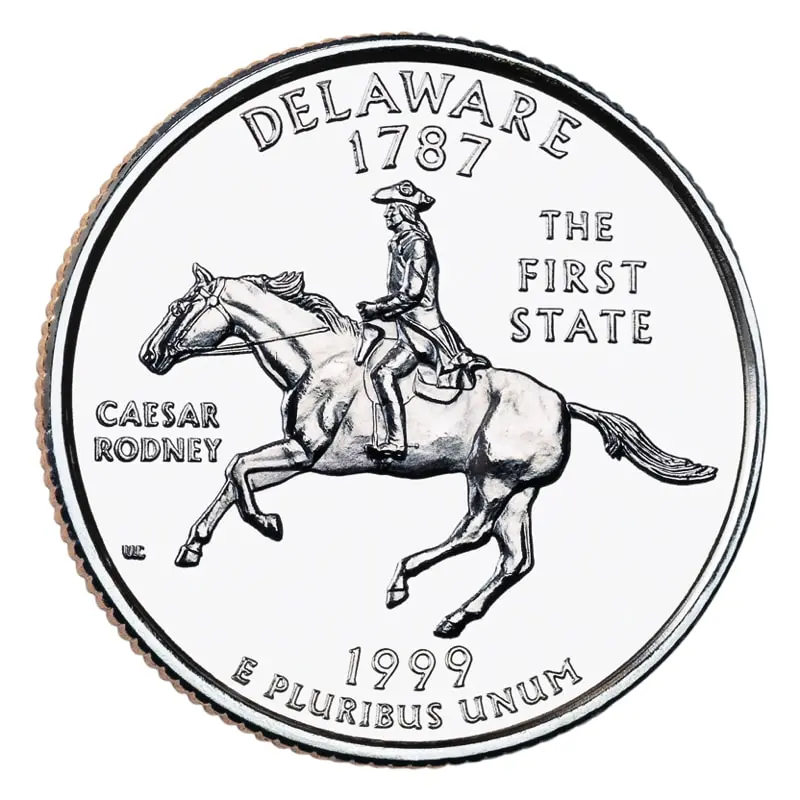
CVC & Collectables presents the 1999-S Delaware State Quarter Gem Proof, a San Francisco–struck clad proof of the very first coin in the 50 State Quarters Program. Deeply mirrored fields and frosted devices showcase Caesar Rodney’s dramatic 1776 ride and Delaware’s proud motto, “The First State.”
Coin Highlights
-
Maker: United States Mint – San Francisco (“S” mint mark)
-
Date: 1999 – inaugural year of the 50 State Quarters series
-
Series / Type: 50 State Quarters – Delaware, clad proof issue for collectors only
-
Metal: Copper-nickel clad (91.67% copper, 8.33% nickel over a pure copper core)
-
Weight / Diameter / Edge: 5.67 g; 24.3 mm; reeded edge
-
Mintage: 3,713,359 clad proof Delaware quarters (same for each 1999-S clad State Quarter)
-
Obverse: George Washington portrait by John Flanagan, updated by William Cousins, with UNITED STATES OF AMERICA, LIBERTY, IN GOD WE TRUST, QUARTER DOLLAR, and “S” mint mark.
-
Reverse: Caesar Rodney on horseback, inscriptions DELAWARE, 1787, THE FIRST STATE, CAESAR RODNEY, 1999, E PLURIBUS UNUM; design and engraving by William Cousins.
Historical Significance
Released on January 4, 1999, the Delaware quarter launched the 50 State Quarters Program and helped ignite a new wave of interest in modern U.S. coinage.
The reverse commemorates Caesar Rodney’s arduous 80-mile overnight ride from Dover to Philadelphia in 1776, undertaken in brutal weather so he could cast the decisive vote for independence. His tie-breaking vote helped secure Delaware’s place among the original thirteen colonies, later becoming the first state to ratify the U.S. Constitution in 1787—hence the “The First State” legend on the coin.
Collectibility
With a mintage of just over 3.7 million pieces—far lower than the hundreds of millions of P and D circulation strikes—the 1999-S Delaware clad proof is a key first-year proof issue prized by State Quarter enthusiasts.
Proof Delaware quarters were struck in both clad and 90% silver compositions; this listing is for the copper-nickel clad Gem Proof, identifiable by its copper-colored edge, while the silver version shows a uniform silver-white edge and carries a lower mintage.